Limiting beliefs are deeply held convictions about yourself — “I’m not enough,” “I’m not lovable,” “I don’t deserve success” — that originated in childhood trauma and now run your life on autopilot, sabotaging your relationships, career, health, and self-worth. They aren’t thoughts you chose. They’re emotional blueprints that were installed before you could read, and they’ve been dictating your decisions ever since. If you’ve tried affirmations, positive thinking, and personal development programs and nothing sticks — it’s not because you’re broken. It’s because you’ve been trying to think your way out of a feeling problem.
That’s you — the one who can list everything wrong with yourself in five seconds flat but can’t accept a compliment without deflecting it.
Limiting beliefs don’t live in your thoughts. They live in your body, in your nervous system, in the chemical patterns your brain has been running since childhood. And until you address what created them — not just what they say — no amount of positive thinking will set you free.
What Are Limiting Beliefs and Where Do They Come From?
A limiting belief is a deeply held conviction about yourself or the world that constrains your choices, your relationships, and your sense of possibility. “I’m not smart enough.” “I don’t deserve love.” “If I let my guard down, I’ll get hurt.” “I’m too much.” “I’m not enough.” These aren’t random thoughts. They’re emotional conclusions your brain drew in childhood — and they’ve been running your life ever since.
That’s you — carrying a belief about yourself that was written by a five-year-old in a moment of pain, and treating it like absolute truth at forty.
Here’s what most personal development programs get wrong: they treat limiting beliefs as a thinking problem. “Just change the thought! Replace the negative belief with a positive one!” But here’s what actually happens in the brain. With every piece of information you take in — whether you see it, hear it, touch it, or smell it — you first have an emotional reaction. All incoming information checks your emotional centers first. Your brain is checking previous emotional experiences so they can be categorized. All of this happens well before you’re cognitively aware.
Limiting beliefs are not thoughts that create feelings — they are childhood emotional experiences that generate automatic thoughts. You become what you feel, not what you think. Until you heal the feeling underneath the belief, no amount of cognitive restructuring will produce lasting change.
Because in the past, you received the message that you’re not capable, not smart, not beautiful, not worthy. You are replaying those feelings. That is why when you try to talk positively to yourself, you can’t believe it. The previously unhealed feeling is more powerful than any affirmation you can construct.
That’s you — telling yourself “I am worthy” in the mirror while your body screams “no, you’re not” — and your body always wins.
Why Can’t Positive Thinking and Affirmations Fix Limiting Beliefs?
Think about a limiting belief you have right now. “I’m not attractive.” “I’m not smart.” “I’m not thin enough.” “I don’t make enough money.” Whatever it is — notice when you think about that limiting belief that the feeling is deeply negative. The feeling matches the thought. That’s because a belief is when your thoughts and your feelings line up.
Now try to change it. Tell yourself “I’m beautiful.” “I’m intelligent.” “I’m powerful.” Notice the feeling hasn’t changed. You don’t feel more attractive, smart, or powerful. The words bounce off the wall of the original emotional experience like tennis balls off concrete.
That’s you — buying the self-help book, doing the exercises, reciting the affirmations for three weeks, and then feeling worse than when you started because nothing changed.
This is why personal development programs produce limited results. They all teach that you need to change the way you think about yourself. But no amount of thinking will change what you feel. The feeling was installed first. The thought was generated by the feeling. Trying to change the belief by changing the thought is like trying to change the weather by moving the thermometer.
Positive thinking and affirmations fail because they target the cognitive output of a limiting belief while leaving the emotional source — the childhood trauma that created the belief — completely untouched. The brain processes emotion before cognition, which means feelings generate thoughts, not the reverse.
That’s the reason every “mindset shift” you’ve tried has had an expiration date — you were trying to overwrite software while the hardware kept running the original program.
How the Worst Day Cycle™ Creates and Maintains Limiting Beliefs
Limiting beliefs aren’t random. They follow a predictable neurochemical pattern called the Worst Day Cycle™. Understanding this cycle is the first step to finally breaking free from beliefs that have controlled you for decades.
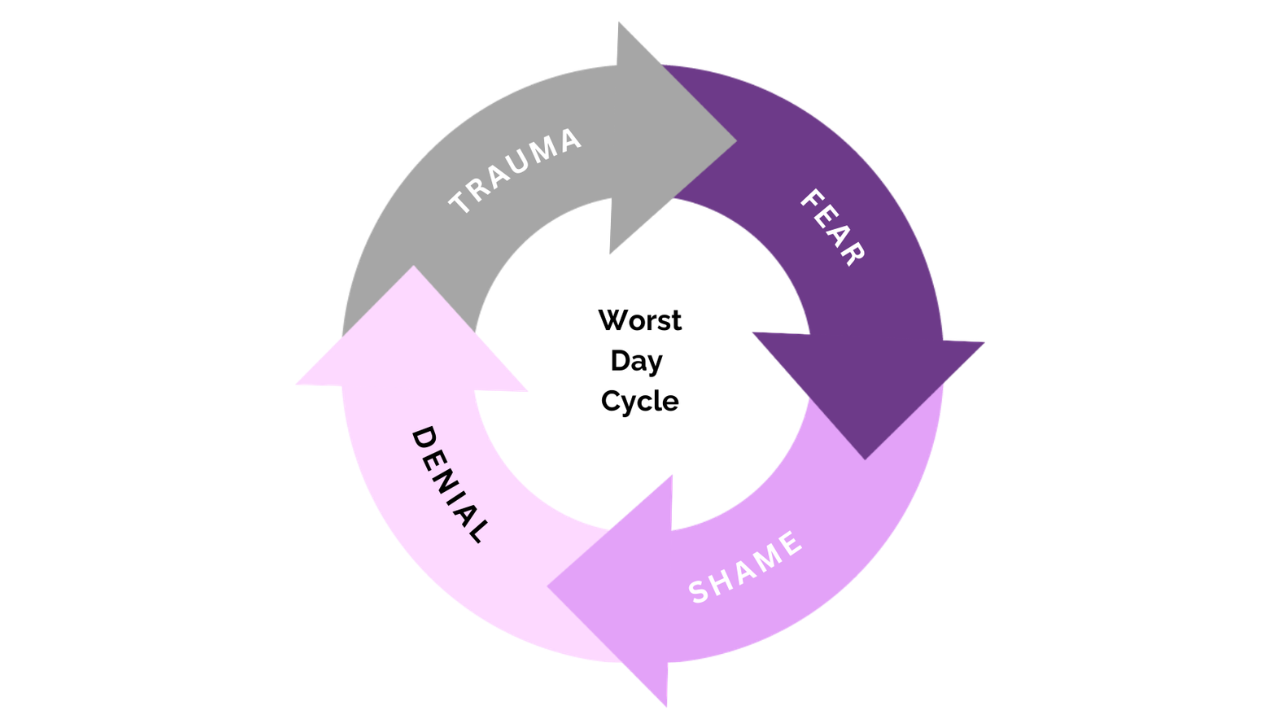
The Worst Day Cycle™ has four stages: Trauma → Fear → Shame → Denial.
Trauma: Any negative emotional experience in childhood that created painful meanings. It doesn’t have to be dramatic — a parent who was emotionally unavailable, a household where feelings were treated as weakness, a caregiver whose love was conditional on performance, a sibling who got more attention. These experiences create a massive chemical reaction in the brain and body. The hypothalamus generates chemical cocktails — cortisol, adrenaline, dopamine, oxytocin misfires — and the brain becomes addicted to these emotional states.
That’s you — wondering why you keep choosing the same painful patterns even though you “know better.” Your brain doesn’t care what you know. It cares what it’s addicted to.
Fear: Fear drives repetition. The brain conserves energy by repeating known patterns — it can’t tell right from wrong, only known from unknown. Since 70%+ of childhood messaging is negative and shaming, adults repeat these painful patterns in relationships, career, hobbies, health — everything. Your limiting belief is the brain’s way of keeping you in known territory. “I’m not enough” keeps you small. Small is familiar. Familiar feels safe — even when it’s destroying you.
Shame: This is where you lost your inherent worth. “I am the problem.” Not “I made a mistake” — but “I AM the mistake.” This is the core wound underneath every limiting belief. You don’t believe you’re not enough because of evidence. You believe it because shame rewired your sense of self before you could defend against it. Shame is the soil that every limiting belief grows in.
That’s the shame talking — the voice that installed the belief so early and so deeply that you can’t tell the difference between the belief and who you actually are.
Denial: Denial is the survival persona you created to survive the pain. It was brilliant in childhood — absolutely necessary. But in adulthood, it sabotages everything. Your survival persona protects the limiting belief by making sure you never go deep enough to question where it actually came from. It keeps you in your head — thinking about the belief instead of feeling into its origin.
The Worst Day Cycle™ reveals that limiting beliefs are not cognitive errors — they are neurochemical addictions created by childhood trauma. The brain became chemically dependent on the emotional state that produced the belief, and it repeats the pattern thousands of times per day without your conscious awareness.
How Your Survival Persona Protects Your Limiting Beliefs
Your survival persona is the identity you created in childhood to navigate an emotionally unsafe environment. It’s not who you are — it’s who you had to become. And it is the guardian of your limiting beliefs. It makes sure you never challenge them, because challenging the belief means challenging the survival strategy — and to the brain, that feels like death.
There are three survival persona types:
The Falsely Empowered: This persona controls, dominates, and rages. Their limiting belief is usually “I have to be in control or I’ll be destroyed.” They overcompensate for the belief by becoming the most powerful person in every room. They don’t look like they have limiting beliefs — they look like they have no limits at all. But underneath the dominance is a terrified child who believes they’re only safe when they’re in charge.
That’s you — the one who built an empire to prove “I’m not enough” wrong, and discovered the empire didn’t change the feeling.
The Disempowered: This persona collapses, people-pleases, and disappears. Their limiting belief is usually “I’m not worth taking up space.” They make themselves invisible to stay safe. They don’t pursue their abilities, don’t ask for their needs, don’t assert their worth — because the childhood blueprint says doing any of those things leads to rejection, punishment, or abandonment.
That’s you — the one who dims your light in every room so nobody feels threatened, and then wonders why nobody sees you.
The Adapted Wounded Child: This persona oscillates between both — controlling one moment, collapsing the next. Their limiting beliefs shift depending on which mode they’re in. In falsely empowered mode: “I don’t need anyone.” In disempowered mode: “Please don’t leave me.” They never land in their authentic self because the limiting beliefs keep pulling them between extremes.
That’s you — swinging between “I can do anything” and “I can’t do anything right” and never knowing which voice is telling the truth.
Your survival persona is the enforcement mechanism for your limiting beliefs — it was designed in childhood to keep you safe by keeping you small, controlled, or compliant, and it will resist any attempt to change the belief because change represents the unknown, and to the brain, unknown equals dangerous.
How Limiting Beliefs Sabotage Every Area of Your Life
Family: You replay your childhood role at every family gathering. If your limiting belief is “my needs don’t matter,” you over-function for everyone. You manage your parents’ emotions. You swallow your reactions. You give and give and give — and then feel resentful when nobody gives back. Your family reinforced the limiting belief, and every interaction with them reactivates the original blueprint.
That’s you — still performing the role your family assigned you at age six, wondering why you feel like a child every time you go home for the holidays.
Romantic Relationships: If your limiting belief is “I’m not lovable,” you choose partners who confirm it. You tolerate behavior that crosses your boundaries because the belief says you don’t deserve better. You confuse intensity with intimacy. You give everything to prove your worth — and then feel devastated when it’s not enough. Or you avoid intimacy entirely because the belief says vulnerability will get you destroyed.
Sound familiar? The person who either gives too much or walls off completely — and can’t figure out why neither approach creates the love they want?
Friendships: Your limiting beliefs determine who you befriend and how you show up. “I’m too much” makes you dim yourself. “I’m not interesting” makes you the permanent listener. “People always leave” makes you keep everyone at arm’s length. You feel lonely even when surrounded by people because the belief won’t let anyone get close enough to actually know you.
Work: “I’m not smart enough” makes you overwork to compensate. “I don’t deserve success” makes you self-sabotage right before the breakthrough. “I have to be perfect” makes you paralyzed by decisions. Your career is a direct reflection of your limiting beliefs — every promotion you didn’t go for, every raise you didn’t ask for, every idea you didn’t share was a limiting belief making your choices for you.
That’s you — watching people with half your talent get ahead because they don’t carry the belief that they’re not allowed to take up space.
Body and Health: Limiting beliefs don’t just live in your mind — they live in your body. “I’m not worth caring for” shows up as ignoring your body’s signals, pushing through exhaustion, numbing with food or alcohol. Chronic stress from limiting beliefs produces sustained cortisol, which damages the immune system, digestive system, and cardiovascular system. Your body has been trying to tell you about your limiting beliefs for years — through tension, pain, insomnia, and illness.
How the Emotional Authenticity Method™ Rewires Limiting Beliefs
The Emotional Authenticity Method™ is the daily practice that actually rewires limiting beliefs at the nervous system level. It works because it targets the body — where the belief actually lives — not just the mind.
Step 1: Somatic Down-Regulation with optional Titration. Before you can challenge any limiting belief, you have to get your nervous system out of survival mode. When you’re activated — heart racing, chest tight, stomach clenched — your brain is in threat response and cannot process new information. Down-regulation calms the system enough to begin. Titration means you go slowly — you don’t force yourself to confront the deepest belief all at once.
That’s you — learning that you don’t have to white-knuckle your way through healing. You can go at the pace your nervous system can actually handle.
Step 2: What am I feeling? Most people with deeply held limiting beliefs have lost connection with their emotions. “Fine” is their default answer. Using the Feelings Wheel, you develop emotional granularity — the ability to name specific emotions instead of lumping everything into “stressed” or “anxious.” When you can name the specific feeling underneath a limiting belief — not just the belief itself, but the feeling that powers it — you’ve taken the first real step toward freedom.
Step 3: Where in my body do I feel it? All emotional trauma is stored physically. When the limiting belief activates, your chest tightens. Your stomach drops. Your throat closes. Your shoulders climb. Locating the feeling in your body is how you move from intellectual awareness to somatic processing — from knowing about the belief to actually meeting it where it lives.
Step 4: What is my earliest memory of this feeling? This is where the rewiring happens. You trace today’s limiting belief back to its childhood origin. You ask: when is the first time I ever felt “not enough”? And you follow the feeling backward — five years ago, ten years ago, fifteen, twenty — until you arrive at the original moment when that belief was installed. Usually by a parent or caregiver who was passing on their own unhealed pain.
That’s the moment everything shifts — when you realize your limiting belief was never your truth. It was somebody else’s pain that was placed into you, and you’ve been carrying it for them your entire life.
Step 5: Who would I be if I never had this feeling again? This is the vision step. It connects you to the Authentic Self Cycle™ and gives your nervous system a new destination — not a positive affirmation plastered over an unhealed wound, but an actual felt experience of who you are without the limiting belief. When the feeling underneath the belief heals, the belief dissolves on its own. You don’t have to argue with it. You don’t have to replace it. It simply loses its power.
The Emotional Authenticity Method™ works because emotions are biochemical events — you cannot change limiting beliefs through thoughts alone. Thoughts originate from feelings, not the other way around. When you heal the feeling, the limiting thought has no fuel to run on.
How the Authentic Self Cycle™ Replaces Limiting Beliefs With Truth
The Authentic Self Cycle™ is the healing counterpart to the Worst Day Cycle™. Where the Worst Day Cycle™ traps you in Trauma → Fear → Shame → Denial, the Authentic Self Cycle™ restores your identity through Truth → Responsibility → Healing → Forgiveness.
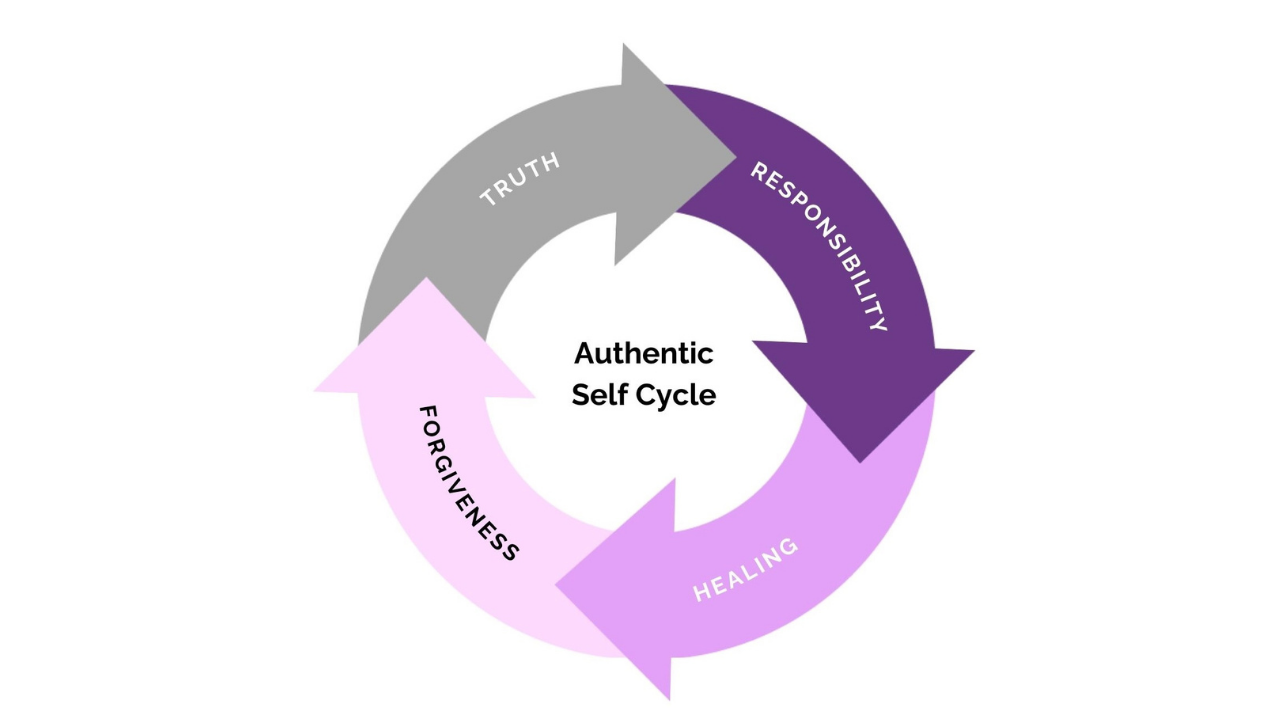
Truth: Name the blueprint. See that “this isn’t about today.” When the limiting belief fires — “I’m not enough,” “I don’t deserve this,” “something bad is about to happen” — truth says: “This belief is from childhood. This feeling was installed by someone who was in their own pain. It was never mine.” This isn’t denial or dismissal. It’s the radical honesty of seeing the pattern instead of being trapped inside it.
That’s the first step out of a limiting belief — recognizing that it’s a recording, not reality.
Responsibility: Own your emotional reactions without blame. “My partner isn’t my parent — my nervous system just thinks they are.” “My boss isn’t the teacher who humiliated me — my body just responds as if they are.” Responsibility means you stop waiting for someone else to disprove your limiting belief. You take back the power that was stolen in childhood by owning the fact that the belief is yours to heal — even though it wasn’t yours to create.
Healing: Rewire the emotional blueprint so the old triggers lose their charge. Conflict becomes uncomfortable but not dangerous. Rejection stings but doesn’t annihilate. Success feels earned, not like something that’s about to be taken away. This is where daily practice does its work — second by second, like the ticks of a clock. The second hand moves in tiny, almost insignificant ticks. But those ticks move the minute hand. The minutes move the hours. Healing works the same way.
That’s you — not looking for the one big breakthrough that changes everything, but showing up for the thousand small moments that actually do.
Forgiveness: Release the inherited emotional blueprint and reclaim your authentic self. This creates a NEW emotional chemical pattern that replaces fear, shame, and denial with safety, worth, and connection. Forgiveness isn’t saying what happened was okay. It’s saying you’re done carrying someone else’s pain as your identity.
It was somebody else’s pain that was placed into you. You’ve been carrying it for far too many years. With the Authentic Self Cycle™, you learn to give it back — not with anger, but with clarity: “I love you. I know you were doing the best you could. But this is your pain, and I will not carry it for you anymore.”
That’s you — not becoming someone new, but finally meeting who you always were underneath the limiting beliefs your family installed.
The Authentic Self Cycle™ is an identity restoration system — it doesn’t paste positive beliefs over negative ones, it heals the emotional wound that made the limiting belief necessary as a survival strategy, replacing the entire neurochemical pattern with one built on truth, worth, and authentic self-connection.
Why Knowing Your Limiting Beliefs Isn’t Enough to Change Them
You probably already know what your limiting beliefs are. You’ve done the worksheets. You’ve identified the patterns. You’ve had the insight. And yet — the beliefs persist. Here’s why.
Knowledge is cognitive. Limiting beliefs are somatic. Knowing that “I’m not enough” came from your father’s criticism doesn’t change the fact that your body still floods with shame every time you make a mistake. Insight without somatic processing is like reading a map without taking a step. It’s useful — but it doesn’t move you anywhere.
That’s you — the person who can articulate their trauma perfectly in therapy and still gets triggered by a single text message.
The brain conserves energy by repeating known patterns. If “I’m not enough” has been running for 20, 30, or 40 years, your neural pathways have been myelinated — literally reinforced with a fatty sheath that makes the signal travel faster and more efficiently. Your limiting belief has a superhighway in your brain. The new belief has a dirt path. That’s why insight alone doesn’t change the pattern. You need repetition — daily, somatic, embodied practice — to build a new neural pathway strong enough to compete with the old one.
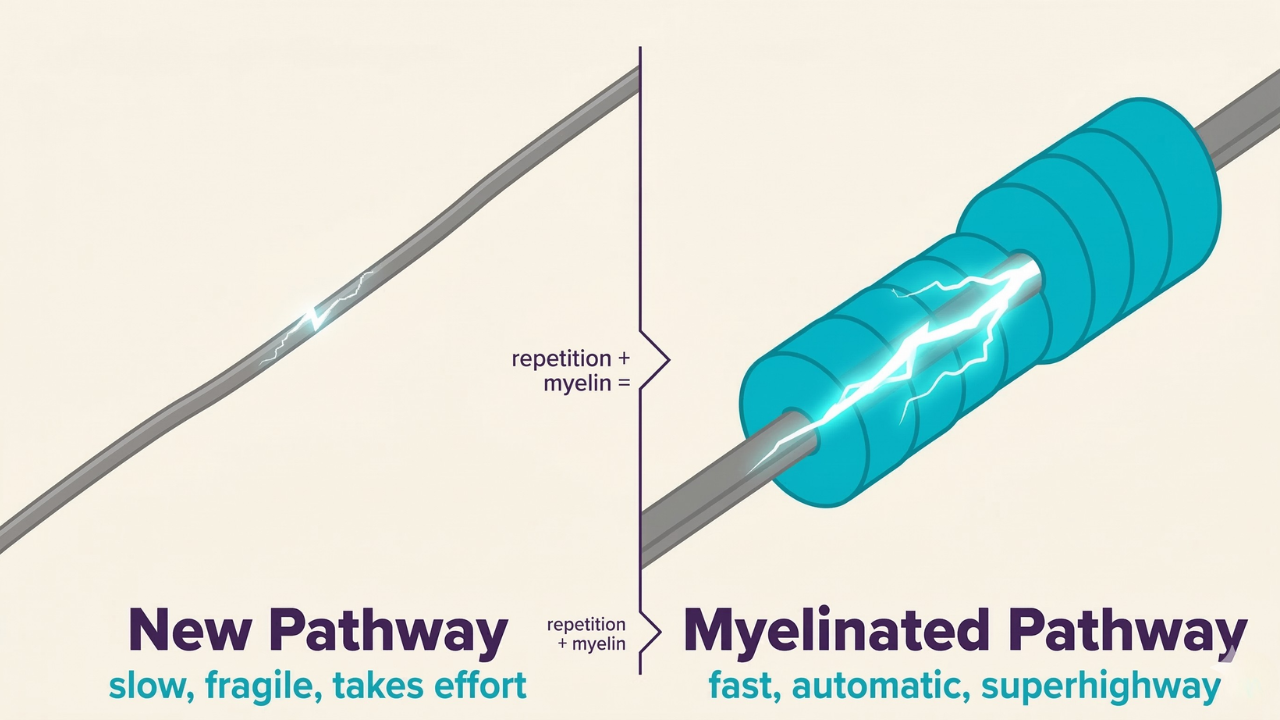
That’s why healing isn’t a breakthrough — it’s a practice. Not dramatic. Not glamorous. But the only thing that actually works.
Frequently Asked Questions About Limiting Beliefs
What are limiting beliefs and where do they come from?
Limiting beliefs are deeply held convictions about yourself — such as “I’m not enough,” “I’m not lovable,” or “I don’t deserve success” — that originated in childhood emotional experiences. They are not thoughts you chose; they are emotional conclusions your brain drew during trauma and encoded into your nervous system. The Worst Day Cycle™ shows how childhood trauma creates a loop of fear, shame, and denial that installs and maintains these beliefs automatically.
Why don’t affirmations work to overcome limiting beliefs?
Affirmations target the cognitive layer of a limiting belief while leaving the emotional root untouched. Since the brain processes emotion before cognition — feelings generate thoughts, not the reverse — repeating a positive thought cannot override the deeper emotional pattern that produced the limiting belief. The Emotional Authenticity Method™ addresses the feeling underneath the belief, which is why it produces lasting change where affirmations cannot.
Can limiting beliefs be completely eliminated?
Limiting beliefs can be fundamentally rewired through consistent somatic practice. The Emotional Authenticity Method™ traces the belief to its childhood origin, processes the unhealed emotion underneath it, and creates a new neurochemical pathway. As the emotional charge diminishes, the belief loses its power. It doesn’t disappear overnight — patterns that have been running for decades require daily repetitive practice — but real, measurable shifts happen within weeks of consistent work.
What is the connection between limiting beliefs and childhood trauma?
Limiting beliefs are the cognitive output of childhood trauma. When a child experiences emotional pain — abandonment, criticism, conditional love, emotional neglect — the brain creates a meaning: “I am the problem.” This meaning becomes chemically encoded in the nervous system through the Worst Day Cycle™ of trauma, fear, shame, and denial. The brain then repeats this pattern to conserve energy, creating a lifelong loop that feels like truth but is actually an inherited survival strategy.
How long does it take to overcome a limiting belief?
Limiting beliefs that have been running for decades don’t reverse overnight. But the Emotional Authenticity Method™ produces noticeable shifts within weeks of consistent daily practice. The key is repetition, not intensity — like the second hand on a clock, each small moment of emotional truth moves the larger pattern. The Authentic Self Cycle™ provides the framework for long-term identity restoration beyond surface-level belief change.
What is the difference between a limiting belief and low self-esteem?
Low self-esteem is the overall experience of not feeling worthy. Limiting beliefs are the specific statements that create and maintain low self-esteem — “I’m not smart enough,” “I’m not lovable,” “I don’t deserve success.” Low self-esteem is the landscape; limiting beliefs are the individual weeds growing in it. The three survival persona types — falsely empowered, disempowered, and adapted wounded child — each produce different patterns of limiting beliefs that all lead to the same core wound: shame.
The Bottom Line
Your limiting beliefs are not your truth. They are somebody else’s pain — placed into you before you could defend against it, automated by a brain that was trying to keep you safe, and reinforced by decades of repetition until they felt like who you are.
They are not who you are.
You didn’t choose them. You didn’t earn them. And you are not defined by them. But you are the only one who can heal them — not by thinking harder, not by affirming louder, not by achieving more, but by feeling into the wound underneath the belief and finally letting it be seen, named, and released.
You become what you feel, not what you think. When you learn to change what you feel — when the feeling underneath “I’m not enough” dissolves because you traced it to its origin and processed it in your body — the belief that grew from it has nowhere to live.
That’s you — not the collection of limiting beliefs that were installed in childhood. The authentic human being underneath who has been waiting their entire life for someone to say: “That belief was never yours. And you can put it down.”
You can put it down. Today. Not through willpower. Through truth. Through feeling. Through the brave, daily practice of meeting yourself exactly where you are — and choosing to stay.
Recommended Reading
These books complement the frameworks in this article and deepen your understanding of how limiting beliefs form and how to heal them:
Facing Codependence by Pia Mellody — the foundational text on how childhood trauma creates the core wounds that produce limiting beliefs and codependent patterns.
The Body Keeps the Score by Bessel van der Kolk — the science of how trauma lives in the body, not the mind, explaining why cognitive approaches to limiting beliefs have fundamental limits.
When the Body Says No by Gabor Maté — how chronic emotional suppression and unhealed limiting beliefs manifest as physical illness and disease.
Codependent No More by Melody Beattie — a practical guide to recognizing how limiting beliefs drive codependent patterns in relationships.
The Gifts of Imperfection by Brené Brown — how shame drives limiting beliefs and why vulnerability is the path back to authenticity and self-worth.
Take the Next Step
If you’re ready to stop managing limiting beliefs and start healing them at the root, Kenny Weiss offers courses designed for people who are done with surface-level solutions and ready for real transformation:
Emotional Blueprint Starter Course — Individual ($79) — Your personal roadmap to understanding the Worst Day Cycle™ and discovering which limiting beliefs are running your life.
Relationship Starter Course — Couples ($79) — For couples ready to see how each partner’s limiting beliefs create the cycle of conflict and disconnection.
Why We Can’t Stop Hurting Each Other ($479) — Deep-dive into the Worst Day Cycle™ and how childhood limiting beliefs create relationship pain.
Why High Achievers Fail at Love ($479) — Built specifically for high achievers whose limiting beliefs created career success but relationship failure.
The Shutdown Avoidant Partner ($479) — Understanding avoidant attachment through the lens of limiting beliefs, trauma chemistry, and survival personas.
Tier 1: Mapping the Blueprint ($1,379) — The comprehensive program for learning and practicing the Emotional Authenticity Method™ to rewire limiting beliefs at the nervous system level.
Download the Feelings Wheel — the free tool used in Step 2 of the Emotional Authenticity Method™ to build emotional granularity and reconnect with the feelings underneath your limiting beliefs.
Explore more: The Signs of Enmeshment | 7 Signs of Relationship Insecurity | 7 Signs of High Self-Esteem | How to Determine Your Negotiables and Non-Negotiables | 10 Do’s and Don’ts for a Great Relationship