A narcissistic parent doesn’t just hurt you in the moment—they rewire your brain. Every time they gaslit you, raged at you, or made you responsible for their emotions, your nervous system learned to expect pain in relationships. You developed a survival persona to protect yourself, and now that same protective mechanism sabotages your adult relationships, career, and sense of self.
A narcissistic parent uses emotional manipulation, lack of empathy, and grandiose behaviors to maintain control and power in the family system, creating childhood trauma that conditions your brain to repeat similar painful patterns in adulthood.
Healing from a narcissistic parent requires understanding the Worst Day Cycle™ that keeps you trapped, identifying which survival persona you developed, and following the Emotional Authenticity Method™ to rewire your nervous system. This isn’t about forgiving them—it’s about reclaiming your authentic self.
Table of Contents
- What a Narcissistic Parent Actually Does to Your Brain
- The Three Survival Personas You Might Be Living
- The Worst Day Cycle™: Why You Keep Repeating the Pattern
- Signs You’re Still Controlled by a Narcissistic Parent (By Life Area)
- The Emotional Authenticity Method™: Your Path Out
- The Authentic Self Cycle™: Breaking Free
- Practical Strategies for Dealing With a Narcissistic Parent Now
- People Also Ask
- The Bottom Line
- Recommended Reading
What a Narcissistic Parent Actually Does to Your Brain
When you grow up with a narcissistic parent, your developing brain doesn’t learn about healthy love. Instead, it learns that relationships are about managing someone else’s emotions, protecting yourself from unpredictable rage, and proving your worth by performing perfection.
Your hypothalamus—the part of your brain that controls your stress response—becomes hyperactive. It starts pumping out cortisol and adrenaline in response to normal emotional stimuli because your childhood taught you that emotion = danger. Your dopamine system gets rewired around intermittent reinforcement: sometimes the narcissistic parent is loving, sometimes they’re cruel, but you never know which version you’re getting. This creates an addiction-like pattern in your brain.
That’s you — the one who still flinches when your partner raises their voice, even though they’re not angry at you.
Narcissistic abuse creates a specific kind of childhood trauma: you learned that your feelings don’t matter, your needs are selfish, and your job is to manage your parent’s emotional state. This isn’t because you were weak. It’s because your brain is supposed to adapt to survive. And it did. But the adaptation that saved you at age 8 is destroying your adult relationships now.
The cruelest part? You probably internalized your narcissistic parent. That voice in your head that says you’re not good enough, that your needs are selfish, that you have to earn love—that’s them. You’re now doing to yourself what they did to you.
The Three Survival Personas You Might Be Living
When you’re a child with a narcissistic parent, you can’t leave. You can’t fight. You can’t reason with someone who has no empathy. So your nervous system creates a survival persona—a version of yourself that might keep you safe, earn crumbs of approval, or at least numb the pain.
There are three primary survival personas people develop. Most of us aren’t purely one—we oscillate between them depending on the situation, relationship, or stress level.
The Falsely Empowered Persona
This is the survivor who decided the best way to handle a narcissistic parent was to become more controlling, more dominant, more grandiose. You might be the overachiever, the perfectionist, the one who has to win every argument.
That’s you — the one who has to be right, who can’t admit mistakes, who controls your relationships to prevent abandonment.
The falsely empowered persona says: “If I can just be perfect, successful, and in control, I won’t be vulnerable to that pain again.” In childhood, this kept you safe. As an adult, it makes you exhausting to be around. You struggle with real intimacy because intimacy requires vulnerability, and vulnerability feels like death to your nervous system.
You might rage at your partner for small things. You might dismiss their feelings as weakness. You might be unable to apologize genuinely. You’re not a bad person—you’re a person whose survival mechanism became a tyrant.
The Disempowered Persona
This is the survivor who decided the best way to handle a narcissistic parent was to become invisible. You learned that your needs were the problem, so you made yourself small, agreeable, and perpetually apologetic.
That’s you — the one who can’t say no, who people-pleases to the point of self-abandonment, who feels guilty for having any need at all.
The disempowered persona says: “If I just disappear, if I just make everyone else okay, I’ll be safe.” In childhood, this kept you alive. As an adult, it makes you invisible even to people who love you. You struggle to access your own anger because anger means you matter, and you don’t believe you do.
You might collapse into depression or anxiety when your partner disagrees with you. You might spend your whole life fixing other people’s problems while ignoring your own. You’re not weak—you’re a person whose survival mechanism became a prison.
The Adapted Wounded Child Persona
This is the survivor who oscillates wildly between falsely empowered and disempowered, depending on the situation. One day you’re raging at your partner, the next day you’re dissolved in shame about it. One week you’re setting boundaries, the next week you’ve completely abandoned yourself.
That’s you — the one who doesn’t know who you are, who changes depending on who you’re around, who feels like you’re living multiple lives.
The adapted wounded child persona is the exhausting pendulum swing between “I need to control everything” and “I need to disappear.” You might cycle through relationships quickly because you can’t maintain the energy required for either extreme. You’re often diagnosed with anxiety, depression, or borderline traits—not because those are your diagnosis, but because you’re literally running two opposite nervous system states on overdrive.
You’re not broken—you’re a person whose survival mechanism is conflicted because both survival strategies were necessary at different times in your childhood.
The Worst Day Cycle™: Why You Keep Repeating the Pattern
You probably thought the narcissistic parent would be different once you became an adult. You probably thought distance, reasoning, or setting boundaries would help. And then you realized: you keep attracting similar people, or you keep recreating the same dynamic with partners, friends, or even your own children.
This isn’t your fault. This is the Worst Day Cycle™.
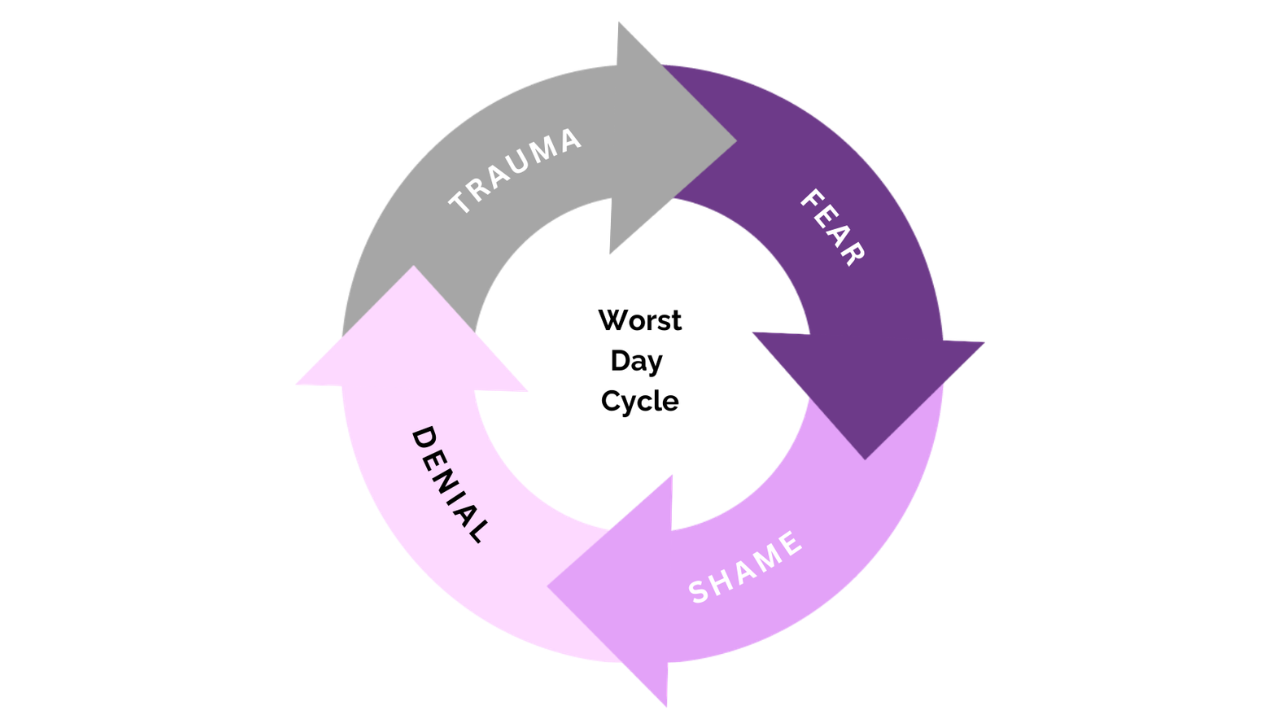
Stage 1: Childhood Trauma
Your narcissistic parent created a specific meaning for you: “I am not safe. My needs are selfish. I cannot trust anyone. My job is to manage other people’s emotions.” This isn’t a thought—it’s a cellular, neurobiological imprint.
Every time they raged, gaslit, invalidated, or abandoned you emotionally, your nervous system recorded it as dangerous. Your brain literally changed its structure. Childhood trauma is real brain damage, not metaphorical.
Stage 2: Fear (The Chemical Reaction)
Your hypothalamus responds to this early trauma by creating a chemical cocktail: cortisol floods your system to prepare you for threat, adrenaline makes you hypervigilant, dopamine creates a craving for the unpredictable patterns that feel familiar, oxytocin misfires and makes you bond with the person who hurt you.
That’s you — the one whose body goes into panic mode at the hint of abandonment, even though you’re 35 years old and safe.
Your brain becomes chemically addicted to these emotional states because repetition signals safety to your developing nervous system. The brain can’t tell right from wrong—it can only tell familiar from unfamiliar. Known pain feels safer than unknown possibility.
Stage 3: Shame (Where You Lost Your Worth)
Over time, the repeated trauma creates a core wound: shame. Not embarrassment—shame. The belief that *you* are the problem. Not “I did something bad,” but “I am bad.”
Your narcissistic parent probably blamed you for their emotions (“You made me angry,” “If you weren’t so difficult, I wouldn’t have to yell”). Your developing brain, which is 100% egocentric until about age 7, believed it. You internalized the belief that your existence causes problems.
This shame becomes the engine of all your adult relationship patterns. You stay in relationships where you’re mistreated because shame says you deserve it. You leave relationships where you’re treated well because shame says you don’t deserve it. You sabotage your own success because shame says you’re not worthy of good things.
Stage 4: Denial (Your Survival Persona)
Your nervous system can’t survive in constant terror and shame, so it creates a denial mechanism—a persona that protects you from the pain. This is your survival persona: falsely empowered, disempowered, or adapted wounded child.
That’s you — the one who says “it wasn’t that bad,” who defends your narcissistic parent, who can’t admit how deeply they hurt you.
Denial is your brain’s survival mechanism, and it’s brilliant—but it keeps you trapped in the cycle. As long as you deny the original trauma, you can’t heal it. You just keep repeating it.
And here’s where it loops: your survival persona creates new conflict, which triggers your nervous system to produce fear again, which triggers shame again, which requires more denial. And the cycle continues through every relationship you have.
Signs You’re Still Controlled by a Narcissistic Parent (By Life Area)
You might not think about your narcissistic parent every day anymore. But their imprint is still running your nervous system. Here’s how it shows up:
In Your Family Relationships
You might find yourself repeating your parent’s patterns with your own children. Or you might overcorrect and be so permissive that your kids have no structure. You might struggle to set boundaries with your narcissistic parent even now, or you might have cut them off completely but feel guilty about it.
That’s you — the one who can’t say no to your parent’s boundary violations, who feels like a terrible person for not “honoring” the person who hurt you.
A key sign is that you feel responsible for managing your parent’s emotions, even as an adult. You call them to check in when you’re stressed. You apologize for things that aren’t your fault. You still seek their approval.
In Your Romantic Relationships
You either attract narcissists (because they feel familiar) or you attract avoidants (because your survival persona is designed to manage someone else’s emotions). You might cycle through relationships quickly, or you might stay in one dysfunctional relationship for decades.
That’s you — the one who can’t relax into a healthy relationship, who waits for the other shoe to drop, who doesn’t believe anyone could actually love you.
The clearest sign is that you abandon yourself in relationships. You become who they need you to be. You don’t express your real needs. You’re constantly anxious about abandonment or suffocated by closeness. You can’t ask for what you want without shame.
Learn more about the signs of insecurity in relationships created by this early trauma.
In Your Friendships
You might be the one who always listens but never shares. Or you might be the one who disappears from friendships when you need support. You might struggle to maintain friendships because vulnerability feels dangerous.
That’s you — the one with no close friends, the one with lots of acquaintances but no one who really knows you.
A key sign is that you don’t have people you can be authentic with. You perform in friendships the same way you performed for your narcissistic parent. The real you stays hidden.
In Your Work Life
Your survival persona is probably running your career. Falsely empowered types become workaholics, perfectionists, and people who can’t delegate or admit mistakes. Disempowered types become people-pleasers who are taken advantage of, who don’t get promoted, who do other people’s work.
That’s you — the one who can’t take feedback without shame spiraling, the one who has to prove your worth through productivity, the one who burns out every few years.
The narcissistic parent taught you that your worth depends on your performance. So your nervous system never lets you rest. You’re always achieving, always trying, always afraid it’s not enough.
In Your Body and Health
Unhealed narcissistic parent trauma lives in your nervous system, and your nervous system is connected to every part of your body. You might struggle with chronic pain, digestive issues, tension, autoimmune conditions, or persistent low energy.
That’s you — the one who goes to doctor after doctor with mysterious symptoms that no one can diagnose.
Your body is holding the emotional blueprint created by your narcissistic parent. You might dissociate during stress, leaving your body entirely. Or you might be hypervigilant, tense and ready for threat at all times. Your nervous system is running in survival mode even when you’re objectively safe.
The Emotional Authenticity Method™: Your Path Out
Here’s the truth that most therapy misses: you cannot think your way out of an emotional pattern. Your narcissistic parent didn’t create thoughts in you—they created *feelings* that live in your body. Until you address the feeling directly, no amount of cognitive reframing will help.
The Emotional Authenticity Method™ is a five-step somatic process designed to rewire your emotional blueprint at the source: in your nervous system, in your body.
Step 1: Somatic Down-Regulation (With Optional Titration)
Before you can access the emotion, your nervous system needs to be resourced enough to tolerate the feeling. This is why trauma therapy sometimes fails—therapists push you to feel things before your nervous system can handle it.
That’s you — the one who doesn’t need to “talk it out,” who needs to calm down first so your thinking brain can come back online.
Down-regulation means sending a signal to your nervous system that you’re safe right now. You might do this through breathwork (4-count inhale, 6-count exhale), cold exposure (splash your face with cold water), movement (shake your body, go for a walk), or bilateral stimulation (cross-lateral exercises).
This isn’t about pushing yourself to “be positive.” It’s about creating the physiological conditions where your nervous system believes it’s safe enough to process emotion.
Step 2: What Am I Feeling?
Most people with narcissistic parent trauma can only identify two emotions: fine and not-fine. This emotional illiteracy keeps you trapped because you can’t address what you can’t name.
That’s you — the one who freezes when someone asks “what are you feeling?” and can only say “I don’t know.”
The Feelings Wheel (available at the bottom of this post) breaks emotion into 12 primary feelings with gradations. Your job is to move past “sad” and get specific: are you disappointed, overwhelmed, heartbroken, or grieving? Are you angry, furious, resentful, or just irritated?
This seems simple, but it’s revolutionary. When you can name the specific emotion your narcissistic parent created, you begin to separate from it. It’s no longer “I am sad”—it’s “I am feeling grief.”
Step 3: Where In My Body Do I Feel It?
All emotional trauma is stored as somatic memory—body memory. Your nervous system remembers what your mind forgot. When you feel grief about your narcissistic parent, where do you feel it? In your chest? Your throat? Your belly? Your legs?
That’s you — the one who holds your breath when conflict starts, who tightens your shoulders when you need to speak up.
Your body is not lying to you. The location of the feeling is significant because it’s where the emotional blueprint is encoded. When you locate the feeling somatically, you bypass the denial mechanisms and access the real wound.
Many people find that when they sit with the physical sensation without judgment, it begins to shift. A tightness loosens. A heaviness lightens. You’re literally rewiring your nervous system’s response by staying present with the sensation.
Step 4: What’s My Earliest Memory of This Feeling?
Your nervous system doesn’t organize emotions by date—it organizes them by pattern. When you feel unsafe in your current relationship, your nervous system doesn’t pull up your partner’s action. It pulls up every time you felt unsafe with your narcissistic parent.
That’s you — the one whose reaction is way bigger than the situation warrants, because you’re not actually responding to today.
When you trace the current feeling back to its earliest memory, you separate past from present. You realize: my partner raised their voice, but my nervous system is responding as if I’m 6 years old and my parent is raging. This recognition is everything. It’s the beginning of choice.
Your job isn’t to re-traumatize yourself by reliving the memory. Your job is simply to acknowledge: this feeling started then. It’s not about today.
Step 5: Who Would I Be If I Never Had This Feeling Again?
This is the vision step. Not “get over it” or “move on.” This is imagining yourself without the emotional blueprint created by your narcissistic parent. Who would you be? How would you move through the world differently?
This isn’t fluffy visualization. This is your nervous system beginning to imagine a new pattern, a new chemical state. Your brain doesn’t know the difference between a vivid imagination and a real experience. When you imagine safety, your nervous system begins to rewire toward safety.
That’s you — the one who could finally relax, finally trust, finally believe you’re worthy of love.
This five-step process addresses the core truth: you cannot change what you don’t feel, and you cannot feel what you don’t locate in your body.
The Authentic Self Cycle™: Breaking Free
Once you understand the Worst Day Cycle™ that keeps you trapped, you’re ready for the counterpart: the Authentic Self Cycle™. This is the healing cycle that gradually replaces the trauma cycle.
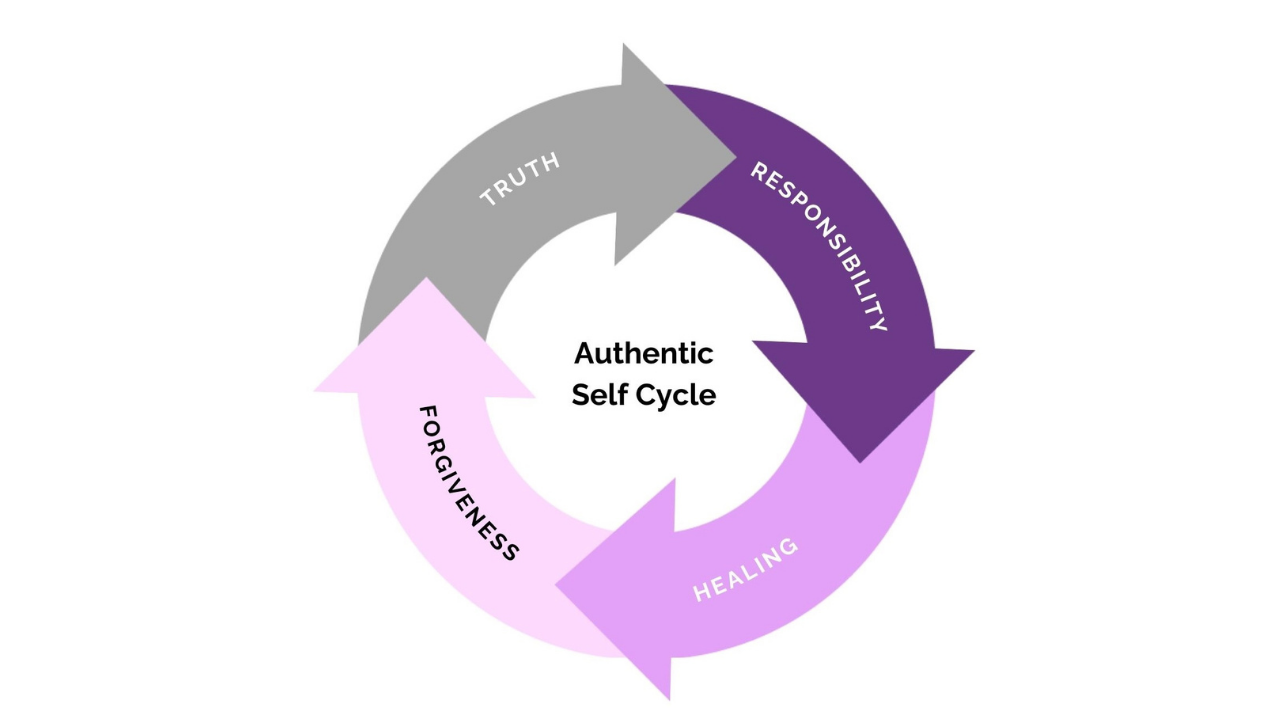
Stage 1: Truth
You name the blueprint. “My narcissistic parent taught me that I’m not safe. That my needs are selfish. That my job is to manage other people’s emotions.” This isn’t about blame—it’s about clarity.
That’s you — the one who can finally say what actually happened, without minimizing or defending the person who hurt you.
Truth is the antidote to denial. As long as you deny what happened, you stay stuck. The moment you tell yourself the truth—even if it’s just internally, even if it terrifies you—something shifts.
Stage 2: Responsibility
This doesn’t mean accepting blame. It means acknowledging: “My parent created this wound, but I’m the one maintaining it now. I’m the one choosing partners who recreate it. I’m the one using my survival persona. I’m responsible for my healing.”
That’s you — the one who stops waiting for your parent to apologize or change, and realizes the only person who can heal this is you.
Responsibility is powerful because it restores agency. You can’t control what your narcissistic parent did. You can control whether you keep the wound open through denial or close it through healing.
Stage 3: Healing
This is where the Emotional Authenticity Method™ comes in. You systematically rewire your emotional blueprint. You send new signals to your nervous system: this conflict isn’t dangerous, this space isn’t abandonment, this intensity isn’t attack.
You reparent yourself—giving yourself the emotional attunement, consistency, and unconditional acceptance your narcissistic parent couldn’t provide. You learn that you can survive disappointment without collapsing. You learn that you can set boundaries without abandonment.
Stage 4: Forgiveness
Forgiveness doesn’t mean reconciliation. It doesn’t mean excusing what your narcissistic parent did. It means releasing the emotional blueprint they created and reclaiming your authentic self.
That’s you — the one who can finally let them go, not for them, but for you.
Forgiveness is the release of the inherited emotional blueprint. Your parent probably had a narcissistic parent too. The wound got passed down. Forgiveness means: I see how this cycle was created, and I’m choosing to end it with me.
This is where the Authentic Self Cycle™ becomes real. You’re no longer running your parent’s emotional program. You’re running your own.
Practical Strategies for Dealing With a Narcissistic Parent Now
Set Boundaries (Or Cut Contact)
You have two choices with your narcissistic parent: set firm boundaries or cut contact entirely. Both are legitimate. The guilt you feel doing either one? That’s the shame your parent installed. Ignore it.
That’s you — the one who feels guilty for protecting yourself, as if your safety is selfish.
If you choose to maintain contact, boundaries are non-negotiable. Not angry boundaries—calm, clear, emotional boundaries. “I won’t discuss my relationship.” “I won’t accept blame for your emotions.” “I won’t respond to guilt trips.”
Boundaries fail when they’re delivered in anger or when you apologize for them. State them once, calmly, and enforce them consistently.
Grieve Your Relationship
You probably fantasize that one day your narcissistic parent will change, apologize, and you’ll have the relationship you always wanted. That’s grief talking. That’s the part of you that still needs them to be the parent you deserved.
That’s you — the one who keeps hoping this time will be different, who still seeks their approval.
You need to grieve the parent you needed and never got. This grief is necessary. It’s painful. And it’s the gateway to your authentic self, because your authentic self doesn’t need a narcissistic parent’s approval.
Identify Your Survival Persona
You can’t change what you don’t see. Which survival persona do you live in most? Falsely empowered (controlling, raging, needing to win)? Disempowered (collapsing, people-pleasing, abandoning yourself)? Adapted wounded child (oscillating between both)?
That’s you — the one who finally understands why you’re exhausting in relationships, why you can’t relax, why you sabotage good things.
Your survival persona isn’t your fault, but it is your responsibility now. Every time you notice it taking over—every time you rage, collapse, or oscillate—pause. Get curious. What triggered it? What scared your nervous system? This awareness is the first step toward integration.
Work With the Emotional Authenticity Method™
Use the five steps every time you feel triggered. Down-regulate. Name the emotion. Locate it in your body. Trace it back. Vision your authentic self. This becomes a muscle over time. Your nervous system learns a new response to old triggers.
Address Your Codependence
Learn the negotiables and non-negotiables of codependence recovery, because narcissistic parent trauma and codependence are usually intertwined. You learned to manage other people’s emotions as a survival strategy. You need to unlearn that.
Get Into the Right Relationship Patterns
Check out the essential dos and don’ts for great relationships so you can build something healthy instead of repeating the narcissistic dynamic.
People Also Ask
Can you ever have a healthy relationship with a narcissistic parent?
Only if you fully separate your emotional blueprint from theirs. Most people can’t do this while in regular contact because the narcissistic parent will keep triggering the old wounds. Some people maintain superficial, boundaried contact. Others find healing requires distance or no contact. Both are valid. The key is that *you* get to decide what protects your healing—not guilt.
What does it mean to reparent yourself?
Reparenting means giving yourself what your narcissistic parent couldn’t: attunement to your emotional needs, unconditional acceptance, consistency, and safety. When you feel shame, you soothe it like a loving parent would. When you need comfort, you provide it. You become internally what your parent failed to be externally. This isn’t about self-indulgence—it’s about rewiring your nervous system’s expectation of care.
How long does it take to heal from narcissistic parent trauma?
There’s no timeline because you’re literally rewiring your brain. Some people feel major shifts in months. Others take years. The metric isn’t time—it’s change. Are you triggering less? Recovering faster from conflict? Able to be vulnerable? Able to set boundaries without guilt? If yes, you’re healing. If you’re still in the Worst Day Cycle™ and haven’t accessed your authentic self yet, you need support.
Is it selfish to cut off a narcissistic parent?
No. Self-protection is never selfish. Your nervous system was injured. Protecting that injury is an act of self-respect. The guilt you feel is the internalized voice of your narcissistic parent telling you that your needs don’t matter. Recognize it. Release it. Choose yourself.
What if I’m starting to become like my narcissistic parent?
This is actually a sign you’re aware. Most people with narcissistic parents either become codependent or unconsciously adopt narcissistic traits themselves. The falsely empowered survival persona often looks like narcissism. But awareness means you have choice. You can see the pattern before it damages your relationships. Use the Emotional Authenticity Method™ to process the survival persona before it acts. Seek support immediately. Healing is possible.
What about extended family members who side with the narcissistic parent?
Family systems are designed to maintain stability, even dysfunctional stability. When you stop playing your assigned role (the guilt-absorber, the fixer, the one who manages the narcissistic parent), the whole system feels threatened. People will pressure you to return to your role. This is normal. It doesn’t mean you’re wrong. It means your healing is challenging the family’s survival strategy. You may need to create distance from extended family too. Your healing comes first.
The Bottom Line: Your Authentic Self Is Still In There
Your narcissistic parent couldn’t destroy your authentic self. They just buried it under layers of survival personas, shame, and denial. But it’s still there—the part of you that knows you’re worthy, that has real needs, that deserves love.
That’s you — the one who’s been trying to earn love from someone incapable of giving it, when the person you actually need love from is yourself.
Healing from a narcissistic parent isn’t about forgetting what happened or pretending it didn’t matter. It’s about reclaiming your life from the emotional blueprint they created.
The Worst Day Cycle™ taught you that you’re not safe, that your needs don’t matter, that you have to manage other people’s emotions to survive. The Authentic Self Cycle™ teaches you the opposite: you are safe, your needs matter, you’re allowed to be yourself.
The Emotional Authenticity Method™ is how you make that transition real—not in your head, but in your nervous system, in your body, where the original wound lives.
You don’t need your narcissistic parent’s permission to heal. You don’t need them to apologize or change. You just need to decide: today is the day I choose myself. And then do the work.
Recommended Reading and Resources
Deepen your understanding with these books from trauma-informed authors:
- The New Codependency: Help and Guidance for Today’s Generation by Melody Beattie — Essential for understanding how narcissistic parent trauma manifests as codependence in your adult relationships.
- The Body Keeps the Score by Bessel van der Kolk — The definitive guide to how trauma lives in your nervous system and how somatic healing works.
- The Myth of Normal by Gabor Maté — Understand the deeper context of how childhood trauma becomes chronic illness and how to reverse it.
- Bradshaw On: The Family by John Bradshaw — A classic on family systems and how narcissistic parents create dysfunctional patterns across generations.
- Dare to Lead by Brené Brown — For building shame resilience and authentic leadership of your own life.
Use the Feelings Wheel exercise daily to build emotional granularity and awareness.
Ready to Go Deeper?
Understanding your narcissistic parent trauma is the first step. Rewiring it requires support, structure, and someone who understands the neurobiology of healing.
These courses will guide you through the Emotional Authenticity Method™ and help you build your Authentic Self Cycle™:
- Emotional Blueprint Starter Course — Individual ($79) — A foundational 5-week course on understanding your emotional blueprint and the three survival personas. Start here if you’re just beginning to recognize the pattern.
- Relationship Starter Course — Couples ($79) — For people in relationships who want to stop repeating narcissistic family patterns with their partners. Learn how to create earned security instead of inherited trauma.
- Why We Can’t Stop Hurting Each Other ($479) — A comprehensive deep dive into how childhood trauma creates relationship conflict, how to interrupt the cycle, and how to build genuine intimacy.
- Why High Achievers Fail at Love ($479) — Specifically for falsely empowered survivors who’ve built successful careers but can’t maintain relationships. Learn why achievement doesn’t fix the wound.
- The Shutdown Avoidant Partner ($479) — If you’re in a relationship with someone whose trauma looks like emotional withdrawal, this course explains how their nervous system works and what actually helps them heal.
- Tier 1: Mapping the Blueprint ($1,379) — The full-spectrum healing program combining the Emotional Authenticity Method™, the Worst Day Cycle™, and the Authentic Self Cycle™. This is the deepest work.
Every course includes video instruction, journaling exercises, the Feelings Wheel, and lifetime access.
See the signs of insecurity in relationships and understand how your narcissistic parent trauma shows up in your love life.
Learn the signs of enmeshment and how emotional boundaries save relationships.
Discover what genuine high self-esteem actually looks like (hint: it doesn’t look like your falsely empowered parent).